
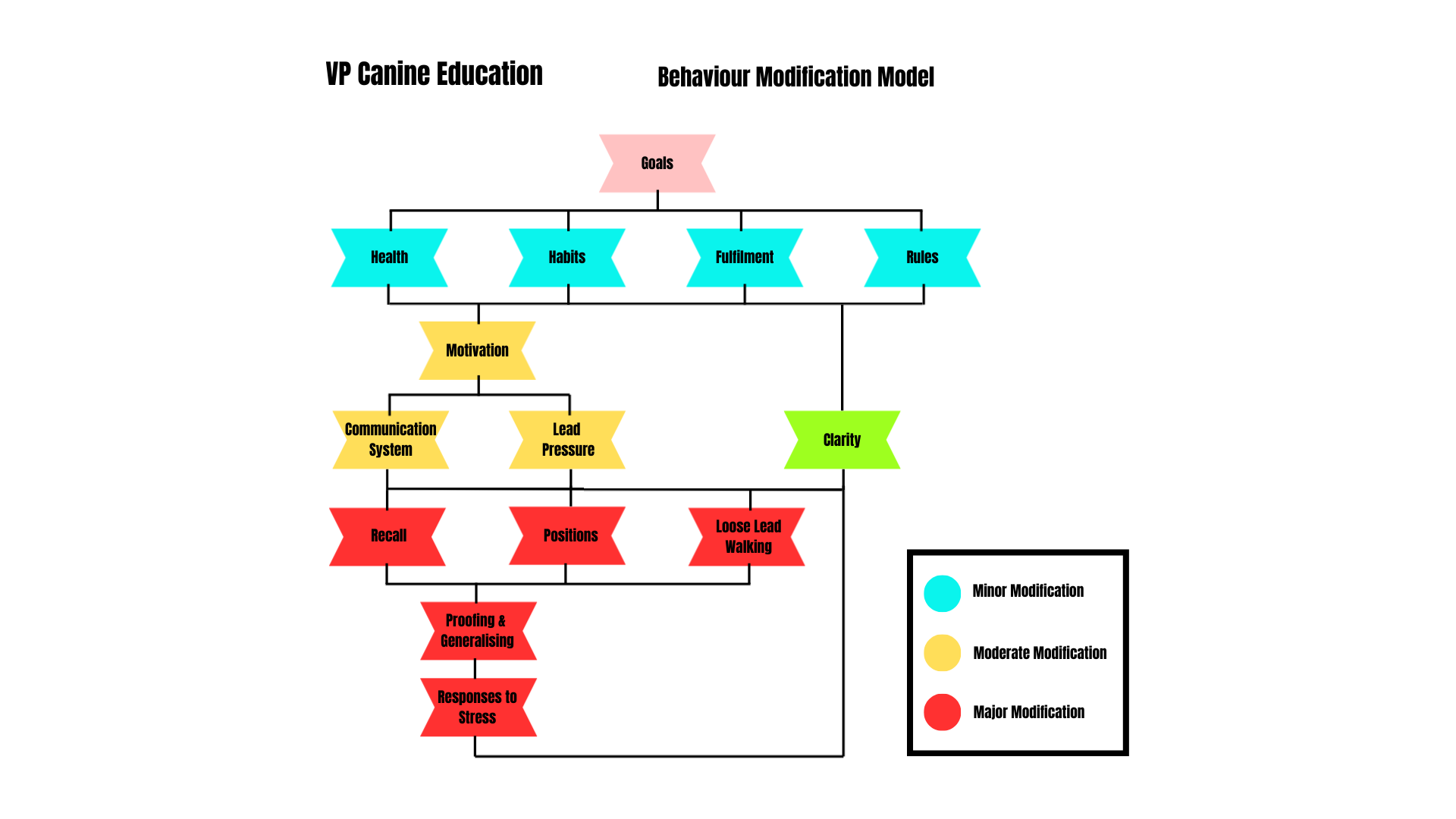
Behaviour Modification Model – Explanation
Introduction
This is not just a behaviour modification model. I truly believe this model can be used to help people take two very important steps BEFORE they get a dog.
The first being choosing the right dog for the household. Whether we like to admit it or not, there are certain types of dogs that simply do not suit the lives we live. Our lifestyle, where we live, who we live with, how much free time we have, what type of people we are; these are all aspects of our lives that we need to consider as possible reasons not to get a certain type of dog. And then there’s the dog! Matching what you can offer the dog with what that particular type of dog needs is a fundamental component of having a good relationship between the two of you.
The second step is forward planning, making sure you and every member of your household has a good understanding of how you want to raise the dog, how you are going to interact with the dog and what rules and boundaries are you going to implement for this dog. Every member of the household MUST be on the same page, following the plan consistently. That is how we’re going to raise a happy, well-behaved dog.
Goals
Before we can start training, we want to ensure we are doing so with a purpose. Having goals to aim for not only helps the relevance of the training, but also the motivation of the owner of the dog which ultimately will benefit the dog later down the line. We should have both short and long-term goals, that are realistic and measurable. So for example, a dog who is in some way ‘reacting’ to other dogs as they pass by; in the short term we could aim to work on our markers (yes/no/ready/enough as examples). As a medium term goal we may aim to get this dog to play/work in a busy environment. The long term goal may be to be able to walk this dog on lead around dogs with the dog being able to be neutral.
The goals we have are going to vary dramatically depending on the dog, the owner and the timescale we have to work with. Generally speaking, the more we have to train and the lower the life experience of the dog, the easier it is to keep aversive experiences to a minimum. A dog with a bite history in a shelter is generally not going to have much time for training, which naturally leads to more ‘extreme’ methods of behaviour modification.
Once we have established our goals, we will look at four of the five fundamental components of behaviour; the fifth being ‘clarity’ but we’ll get to that later.
Health
It should come as no surprise that health is one of if not the first components we look at, whether we’re doing behaviour modification or just deciding what dog/puppy we’re going to take home. Dogs with physical/mental health issues are more likely to suffer with stress, a leading cause of unwanted/inappropriate behaviour from our dogs. Sure, a little stress in a controlled environment as part of training can be highly beneficial. But a dog who is highly stressed during training and/or is consistently stressed throughout the day is not going to behave in the manner we would hope for.
So, what steps can we take to be proactive here? Firstly, understanding the breed of dog we have/are thinking of getting is a necessity. Because of genetics, some dog breeds are more susceptible to specific health conditions. French bulldogs are likely to suffer with breathing problems. German Shepherds have an above average rate of hip & elbow dysplasia. Knowing what health issues your dog is likely to face can not only help identify them in advance; it can allow you to be aware of potential problems in the future and monitor them closely with blood tests, health checks and regular ‘rub downs’.
Finally, we can’t leave the topic of health without quickly mentioning how much difference we can make to a dog's general health by providing them with a good diet and adequate exercise.
Habits
When people think of bad habits they typically think of smoking, drinking alcohol, watching too much TV or eating excessively. Things that we do regularly that don’t have any benefits for doing or have negative consequences for doing them. The problem with these ‘bad habits’ is that they are often automatic and done without conscious thought.
It is often the case that bad habits of the dog owner are the cause of bad behaviours in our dogs. Food being left on tables/worktops encouraging the dog to explore ‘counter surfing’. Loving on the dog every time they push into our space. Overshadowing verbal cues with physical signals, causing confusion in the communication between the two. Dogs are very sensitive to repeated behaviours with consistent outcomes and are highly adept at recognizing patterns. We should be mindful of this, purposely creating ‘good habits’ and eliminating the bad.
Fulfilment
Of the four fundamental components of behaviour, this is the most ‘dog dependent’. Many people seem to believe that a walk around the block, food in the belly, a bed to sleep on and a little love every now and then is all a dog should need. For some dogs that might be the case, but for the vast majority it simply isn’t. The truth is, there are many breeds that were bred for a specific purpose, such as herding, protection, hunting, odour detection and the list goes on.
Now, there are exceptions within every breed. You may have a Spaniel who doesn’t seem to enjoy using its nose, a Border Collie with little interest in herding, or a Labrador who will not hold or retrieve items. These are anomalies, not the norm and should not be taken as an indication that breed traits are unreliable or irrelevant.
As the dog’s owner, it is your responsibility to learn about your dog's purpose, their natural drive and provide it with opportunities to participate in such activities or at least find an activity that spins similar dials within the dog for it to feel fulfilled.
Rules
Rules themselves matter little to the dog once they are understood. What matters most is how those rules are implemented, the consistency with which they are enforced and the consequences that follow when they broke. Examples of rules many implement include; no playing in the house, no jumping on the sofa or no going into bedrooms.
Rules that are implemented from day one are easier for the for the dog to understand. The longer we wait to implement them, the harder it becomes, which is why we always recommend planning these things in advance. Sure, cuddling your puppy on the sofa or letting them nibble your hands may be cute at first, but will that still be the case when the pup is a fully grown dog?
When we say that consequences should proceed any breaking of the rules, we are not advocating for abuse. Removal of something the dog wants (toy/attention), social/spatial pressure or a bop on the nose with a firm “no”. These are all examples of consequences that make it clear to the dog ‘what you did is not allowed’. It’s information that should be delivered without emotion. Again, we must iterate that consistency is key! Without it, we cannot expect the dog to understand the rules.
Level 1 Complete
For some dogs, simply improving their health, stopping the owners' bad habits, giving the dog an outlet to express its ‘natural drive’ or implementing clear rules will be enough to modify/solve the behaviour without need for any further training. These are the minor modifications. For those who need more, we move on the level two.
Motivation
Before we can build a communication system, we want the dog to be a willing participant in such an endeavour. We can skip this part for dogs who show high levels of food or play drive, but for those who are lacking in this department, we may have to spend some time here.
The things we do to build such motivation will vary from dog to dog. In essence, we are going to investigate the different aspects of play with the dog to find what suits them best. For some, we may find that games such as the ‘treat chase game’ is the one. For others it may be tug, fetch, scent games, weight pulling, wall climbing, even wrestling!
It should also be mentioned that these games in themselves will also vary depending on the confidence of the dog and the relationship between the dog and the owner. A dog who is lacking in confidence and/or doesn’t have much rapport with its owner may need a much more ‘tame’ version of the game. This may mean letting the dog ‘win’ every time they pull on a tug, or playing a version of fetch where the owner is doing most the chasing and catching. The point of this section is not to implement rules into the game, or ask for obedience whilst playing. We are simply trying to build confidence, rapport and motivation. Once we feel like the dog is motivated to participate in whatever activity we have been working on, we can use this motivation for the next step.
Communication System & Lead Pressure
Now that we have a dog who is motivated for some type of reward, be it food, love or play we are now going to work on our verbal and physical communication. Here it is important to know the difference between a ‘marker’ and a ‘cue’. Markers are words we use to give a dog feedback on something they have done/are doing, whereas cues are words that either prepare or ask the dog to do something.
The markers we need to work on here are:
“Yes” – You did that right, here’s your reward.
“Good” – You are doing that right, keep going.
“No” – That was wrong, here’s your consequence.
“Ah ah” – That was wrong, try again.
The cues we need to work on here are:
“Ready” - Get ready, we’re about to do something fun.
“Enough” - We’re all done here, go chill out.
“Okay” - You’re free to do as you please.
These words have absolutely no meaning to the dog at first and must be taught both actively and passively – meaning we will set up activities like the one we were working on in step six to teach them, but we will also have to be mindful of how we use them in our during our days living with the dog. We could discuss the intricate details of markers and cues however that would be an essay by itself. Below is just one example of how we can teach these words.
Context – we have been working on building a game of tug with a dog who once lacked confidence and are now introducing these words. We cue the dog to start a game of tug by saying “ready” and the dog looks at us. We then say “yes” and present the tug for the dog to grab. We then start playing, saying “good” to encourage the dog to keep playing. After a while the dog slips off the tug. When the dog goes to grab the tug again, it misses and grabs our hand by mistake. We then say “no” and remove the tug from the dogs' view, placing it in our back pocket, or we could apply a little social pressure after the “no”. Anything that tells the dog that he/she just broke the rules of the game! We then pull the tug back out and say “okay” - the dog grabs the tug again. We play for another minute or so, before saying “enough” and walking away from the dog. The dog then tries instigating play with us, at which point we say “ah ah”. The dog then goes away with the toy before dropping it on the floor.
As for lead pressure, our rule is as follows; if the dog pulls on a lead whilst being walked, or is likely to ignore/be too overstimulated to listen to cues when out on walks, then there’s a good chance the dog will benefit from being taught how to turn off the lead pressure and what to do when it feels a ‘pop’ on the lead. For inexperienced dog handlers, hiring a trainer to help with this or studying videos on the subject will be highly beneficial. To give a quick guide of how we would go about doing this, follow the points below:
Apply gentle lead pressure in a direction and use a piece of food/toy to then lure the dog in this direction.
When the dog moves in said direction, we say “yes” and reward with the food/toy.
The lead pressure will automatically turn off when the dog moves in said direction.
Do this in all directions (forward, backwards, both sides) and before long the dog will be following the lead pressure like a lure.
We can also teach the dog that a gentle ‘pop’ on the lead means to look towards me.
To do this, get dogs’ attention, before giving a gentle but noticeable pop on lead.
Then immediately reward with food/toy.
Repeat until when dog is not paying attention, we can gently ‘pop’ the lead and the dog will turn and come running for its reward.
Level 2 Complete
For the ‘moderate modifications’, simply teaching the dog these markers and cues is going to be enough to stop the target behaviours. Be aware that the meaning of these words can quickly fade if the reinforcement of them is suddenly stopped or you are inconsistent with them. However, for those who need more we move on the level three.
Recall, Positions & Loose Lead Walking
Teaching a formal recall or positions is not always required, especially when we have cues like “ready”. However, in the more extreme cases a dog may choose chasing squirrels or attacking dogs over a game of tug or whatever reward event we have been working on. By teaching a formal recall and/or positions, we can now hold the dog accountable for its own actions.
Teaching a dog a formal recall, positions and how to walk nicely on a lead is extremely simple, especially when we have our markers in place and have taught the dog how to turn off leash pressure. There are countless videos online, books and articles all on this subject so going into detail here is simply unnecessary. Below are some basic principles that we recommend following when teaching these behaviours.
Start with minimal distractions
Keep sessions short & do them often
Monitor your progress
Film yourself when possible to watch back later (helps spot mistakes your making)
Be patient, every dog learns at a different pace
Have fun! Training should be fun for you and the dog
Proofing & Generalising
This is the concept of increasing the difficulty of what you have been working on with your dog up until now. Here we are going to start exploring the world, going to new places, new environments and doing everything we have been doing from scratch. This doesn’t just involve working on the recall, positions and loose lead walking. Building engagement is a step almost everyone seems to forget, however it is by far the most important!
So, like we did in level two, we are now going to start working on the dogs’ motivation to stay engaged with us in these new environments first, before then working on things like recall, positions and loose lead walking. That means whatever activity we have been using as our reward event is exactly what we’ll be trying to get the dog doing. Once the dog is happy to participate in the activity, then we can introduce the less fun stuff!
When we are in the stage of proofing and generalising, we must still break this down into stages, going from an environment where there are less distractions and less variables before gradually exposing the dog to busier/more difficult places.
It is important to note that if your dog has ‘triggers’ that when presented elicit the behaviours we are working to stop, we must do our best to avoid them throughout this process until the dog is ready. If the dog is triggered by cars driving by, we will do our work everywhere except for near cars. If it’s strange dogs, then they are what we are going to avoid. In the unlikely scenario where the ‘trigger’ simply cannot be avoided, we will go to the next step first, before proofing and generalising after. However, this is something that we will always work around when possible.
Responses to Stress
Up until this point, we have been working on everything we’ll need to finally tackle the dogs’ triggers. Now it is time to put it all into action. There are many different strategies we can use to tackle the trigger, but the concept will usually involve exposing the dog to the trigger whilst giving the dog plenty of opportunity to participate in an alternative. As we move forward in this process, we will gradually increase the difficulty of the exposure whilst also allowing the dog more opportunity to make its own decisions.
Due to the complexity of this stage, there is not necessarily a step-by-step process to follow. There are however some points you should know.
We can break a trigger down into three different variables; distance, duration and intensity.
Distance – how far away are we from the trigger?
Duration – how long is the trigger present?
Intensity – how provocative is the trigger?
We should focus on one variable at a time, before looking to combine.
At first we should look to combine exposing the dog to the trigger with getting the dog to engage with us.
Then we should progress to exposing the dog to the trigger whilst not being engaged with us.
We should always start by setting the dog up to succeed, not fail! If we are failing on the first rep, we must decrease the difficulty immediately.
If the dog chooses to engage with us rather than the trigger, we have had a successful rep, which should be rewarded.
If the dog chooses to perform the target behaviour and engages with the trigger, we must let the dog know that this is no longer an option, using our “no” marker along with some form of consequence.
The time between these reps should be equal or more than the time spent during the rep, allowing the dog to decompress.
If the dog does fail and we administer some form of punishment, we must then reconcile with the dog before beginning the next rep, ensuring that there are no negative associations between the dog and the handler.
We must look to ‘run it back’ as soon as possible when the dog has failed.
If the dog is failing frequently (three times in a row), we should look to change strategy or decrease the difficulty immediately.
Always try to end on a successful rep.
Hiring a trainer for this level of behaviour modification is something we will always recommend.
Conclusion
I fully acknowledge that this model does not capture all the nuances involved in canine behaviour modification. Behaviour modification is a highly complex subject, especially when looking at a completely different species, one that doesn’t speak our languages, nor does it think in a similar way to humans. This model was intended to help the regular pet dog owner understand what is behind the curtain of their own dog's behaviour and why simply tackling the issues they have head on may not always be the best idea.
As I mentioned at the very start of this explanation, I truly believe that this model can also be used to help raise a ‘happy well-behaved dog’ simply by following the steps provided - up until the point where we begin tackling triggers. Ensuring that a dog is healthy and has its basic needs met is something we can all do as dog owners. Building a clear communication system and using it with consistency and consideration not only benefits the dog owner, but it gives the dog the final piece of that jigsaw.
What is that final piece I hear you ask? Clarity. The clarity of knowing what is expected of them, and the clarity of knowing how to function in the world we have placed them in.